
When discussing breast cancer survival rates, the phrase “5-year survival” is one of the most commonly quoted statistics. It is useful because it helps measure treatment outcomes and compare results across studies. However, it should never be viewed as the complete picture.
Breast cancer is not a single disease. It consists of multiple biological subtypes, each with its own pattern of growth, recurrence, and long-term prognosis. Understanding these differences is essential for patients, caregivers, and healthcare professionals alike.
Why 5-Year Survival Matters
The 5-year survival rate refers to the percentage of people who are alive five years after being diagnosed with breast cancer. Thanks to advances in early detection, surgery, radiotherapy, chemotherapy, endocrine therapy, targeted therapy, and precision oncology, survival has improved dramatically over the past few decades.
While this statistic is an important milestone, it does not always reflect the long-term risk of recurrence or the biological behavior of different breast cancer subtypes.
Different Breast Cancer Subtypes, Different Timelines
HR+/HER2− Breast Cancer
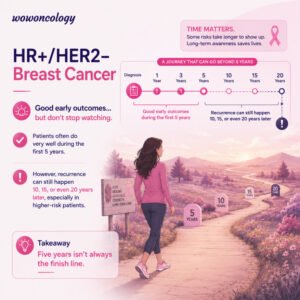
Hormone receptor-positive, HER2-negative breast cancer often has an excellent early prognosis. However, its recurrence risk can continue well beyond five years, with some patients experiencing recurrence 10–20 years after diagnosis. This is why long-term follow-up and appropriate endocrine therapy remain important.
Triple-Negative Breast Cancer (TNBC)
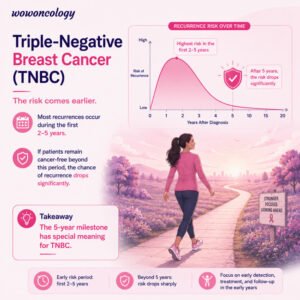
Triple-negative breast cancer behaves differently. The highest risk of recurrence is usually within the first 2–5 years after diagnosis. Patients who remain disease-free beyond this period generally experience a significantly lower likelihood of later relapse, making the five-year milestone particularly meaningful for this subtype.
HER2-Positive Breast Cancer
HER2-positive breast cancer was once associated with aggressive disease and poorer outcomes. Today, anti-HER2 targeted therapies have transformed treatment, leading to substantial improvements in survival and long-term disease control for many patients with early-stage disease.
Looking Beyond the Headline
When interpreting breast cancer clinical trials, clinicians often ask important questions beyond the reported survival rate:
- How long were patients followed?
- How many recurrence events occurred?
- Is five years enough to understand the true benefit of treatment for this subtype?
For many patients—particularly those with HR+/HER2− breast cancer—long-term follow-up provides a more complete understanding of outcomes than a five-year statistic alone.
The Take-Home Message
Five-year survival is an important benchmark—but it is not the whole story. Modern breast cancer care increasingly recognizes that tumor biology, molecular subtype, and long-term follow-up are just as important as survival statistics.
As precision medicine continues to advance, understanding these differences helps patients make informed decisions and enables clinicians to provide more personalized care.
Because in breast oncology, time is not just a statistic—it often tells the real story.
References
- European Society for Medical Oncology (ESMO) Breast Cancer Guidelines
- PubMed – NATALEE 5-Year Follow-up Study (HR+/HER2− Early Breast Cancer)
- National Comprehensive Cancer Network (NCCN) HER2-positive recurrence patterns study (PubMed Central)